
Last reviewed: November 12, 2026
Disclosure: This article is for educational purposes only and is not financial advice. Cryptocurrency prices and market access can change rapidly. Verify all contracts, markets and fees immediately before trading.
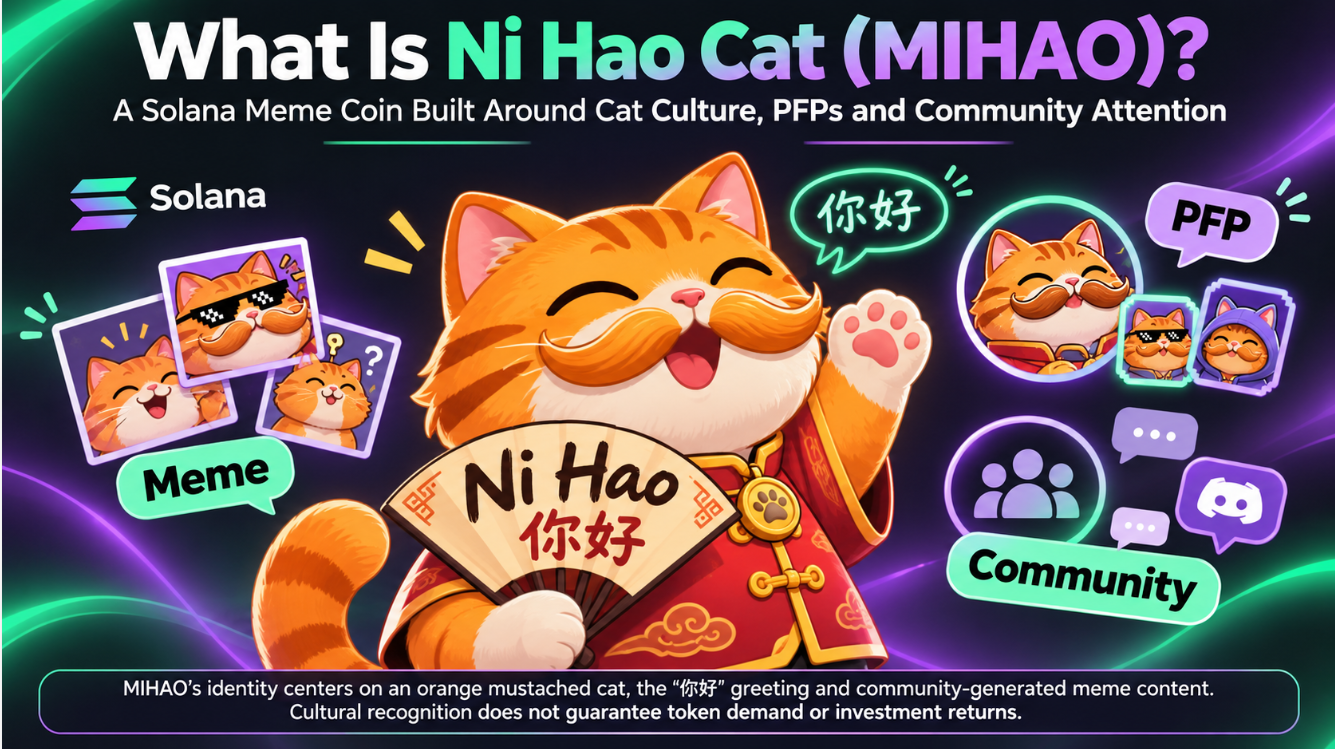
Ni Hao Cat (MIHAO) is a community-driven Solana meme coin launched through Pump.fun on October 25, 2026. Its identity centers on an orange, mustached cat and the Chinese greeting “你好” (“ni hao”). MIHAO has no established cash-flow model or essential token utility; its value primarily depends on attention, community participation, liquidity and market sentiment. It trades mainly on Solana DEXs, with some centralized-exchange support.
Key takeaways
- MIHAO is an attention asset, not a claim on business revenue, protocol fees or equity.
- The verified Solana mint address is
4CxjZyMNoF1p6eXHXHv1TWpS2X47CuUmLwtGe18spump. - The official website offers a meme library, PFP generator and ecosystem directory, but these are community tools rather than proven sources of token demand.
- Market data is extremely volatile. At the November 12, 2026 snapshot used in this article, CoinGecko showed a price near $0.02469, market capitalization near $23.23 million and 24-hour volume near $127.37 million.
- A high trading volume does not guarantee deep liquidity. Pump.fun’s token page showed roughly $228,000 of liquidity in the main SOL pool at one snapshot—far below reported aggregate daily volume.
- A 2030 MIHAO forecast should use market-cap scenarios, not a precise target generated from a short trading history.
- MIHAO may suit experienced meme traders using a small risk budget. It is not a suitable core holding for investors who need stable cash flow, transparent valuation or low volatility.
1. What Is Ni Hao Cat (MIHAO)?
Ni Hao Cat is a Solana meme coin built around a recognizable cat character, bilingual internet humor and community-created profile pictures. MIHAO is not currently presented as a DeFi protocol, AI network or revenue-producing application. The investment case therefore depends on whether its culture can continue attracting attention and converting that attention into holders, liquidity and repeat participation.
Ni Hao Cat project facts

The official website describes MIHAO as “a cat, a world, infinite possibilities.” It displays 289 meme images, a profile-picture generator with 218 possible cat combinations and a directory of tokens paired with MIHAO. These features matter because meme coins compete for cultural participation. They give holders material to share and a visual identity to adopt.
They do not, however, create the same economic foundation as protocol revenue or mandatory token usage. A PFP generator can improve distribution without creating lasting buy pressure. The central research question is therefore not whether the cat is memorable; it is whether people will still want to use, share and trade the identity after the first speculative wave fades.
What makes MIHAO different from other cat coins?
MIHAO’s potential distinction is the combination of an instantly recognizable character, a simple bilingual phrase and user-generated content. “Ni hao” is easy for many non-Chinese speakers to recognize, while the mustached orange cat works without translation. This can lower the friction of international meme distribution.
Yet cultural familiarity should not be mistaken for guaranteed adoption. A Chinese theme does not automatically produce a Chinese investor base, official endorsement or durable global community. Investors should measure the result—unique holders, repeat contributors, organic content and trading depth—rather than assuming the theme itself is a moat.
2. How Does MIHAO Work on Solana?
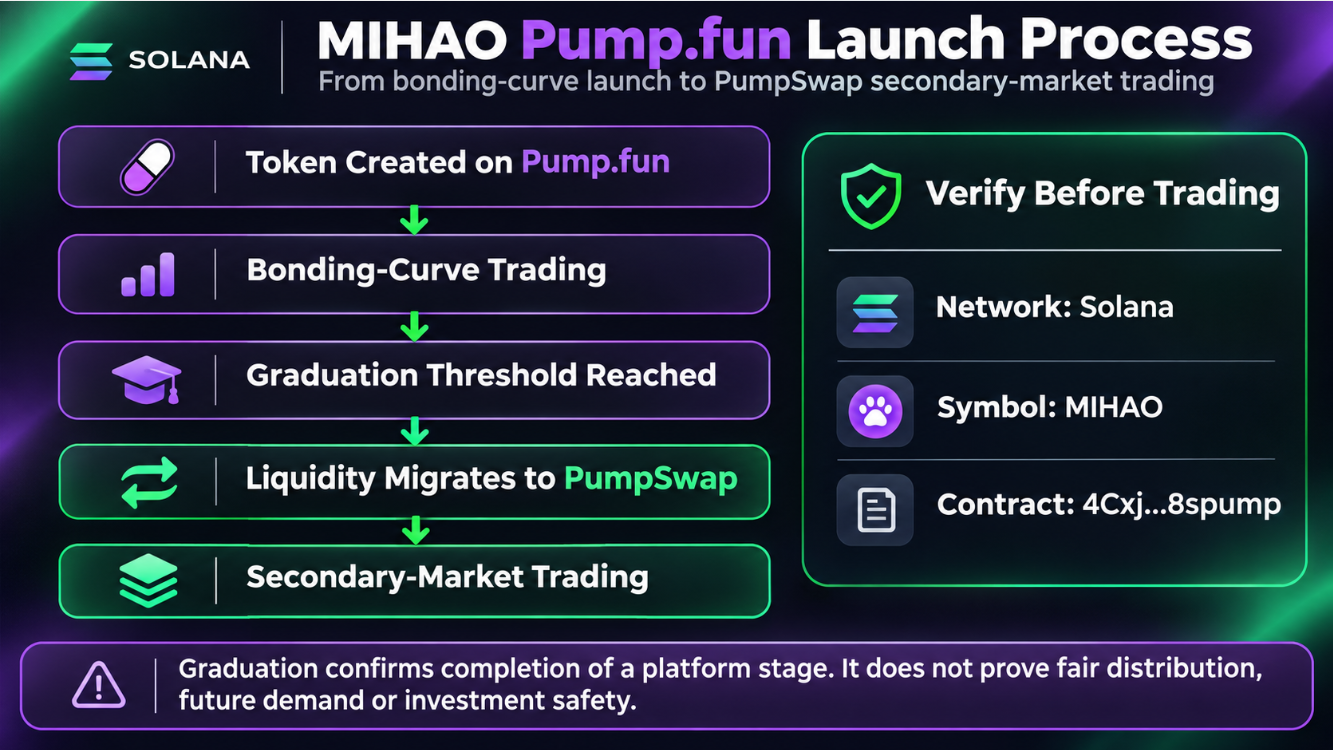
MIHAO is a Solana token created through Pump.fun. Pump.fun’s documented process makes a new coin immediately tradable on a bonding curve; when the curve reaches the platform’s graduation threshold, its liquidity migrates to PumpSwap. MIHAO now has a PumpSwap pool, so its current market is no longer limited to the initial bonding-curve phase.
Why launch on Solana?
Solana offers fast settlement, comparatively low transaction costs and a large retail meme-trading ecosystem. Those characteristics make small, frequent swaps practical, which is useful for coins driven by social momentum. They also make it easy to launch many competing tokens. Low issuance friction expands opportunity but greatly increases noise, imitation and short-lived projects.
Ethereum remains the largest smart-contract ecosystem by many measures, but its base-layer fees can be less attractive for small meme trades. This does not make Solana coins safer. It simply changes the transaction economics. Investors comparing market cycles can use an Ethereum price prediction as a broad risk-sentiment reference, not as a direct MIHAO valuation model.
How the Pump.fun launch process affected MIHAO
The verified Pump.fun page shows that MIHAO was created on October 25, 2026. The token began on a bonding curve, where each purchase or sale altered the curve price. Pump.fun states that graduated coins migrate liquidity to PumpSwap. MIHAO’s active PumpSwap market is evidence that the token passed into that later trading phase.
Graduation should not be interpreted as fundamental validation. It shows that the coin satisfied a platform-specific market threshold and obtained an AMM pool. It does not prove product-market fit, fair distribution, future listings or long-term demand.
How to verify the correct MIHAO token
Solana tokens are identified by their mint address, not by their name or logo. The verified address displayed by the official MIHAO site, Pump.fun, CoinGecko and Solscan is:
4CxjZyMNoF1p6eXHXHv1TWpS2X47CuUmLwtGe18spump
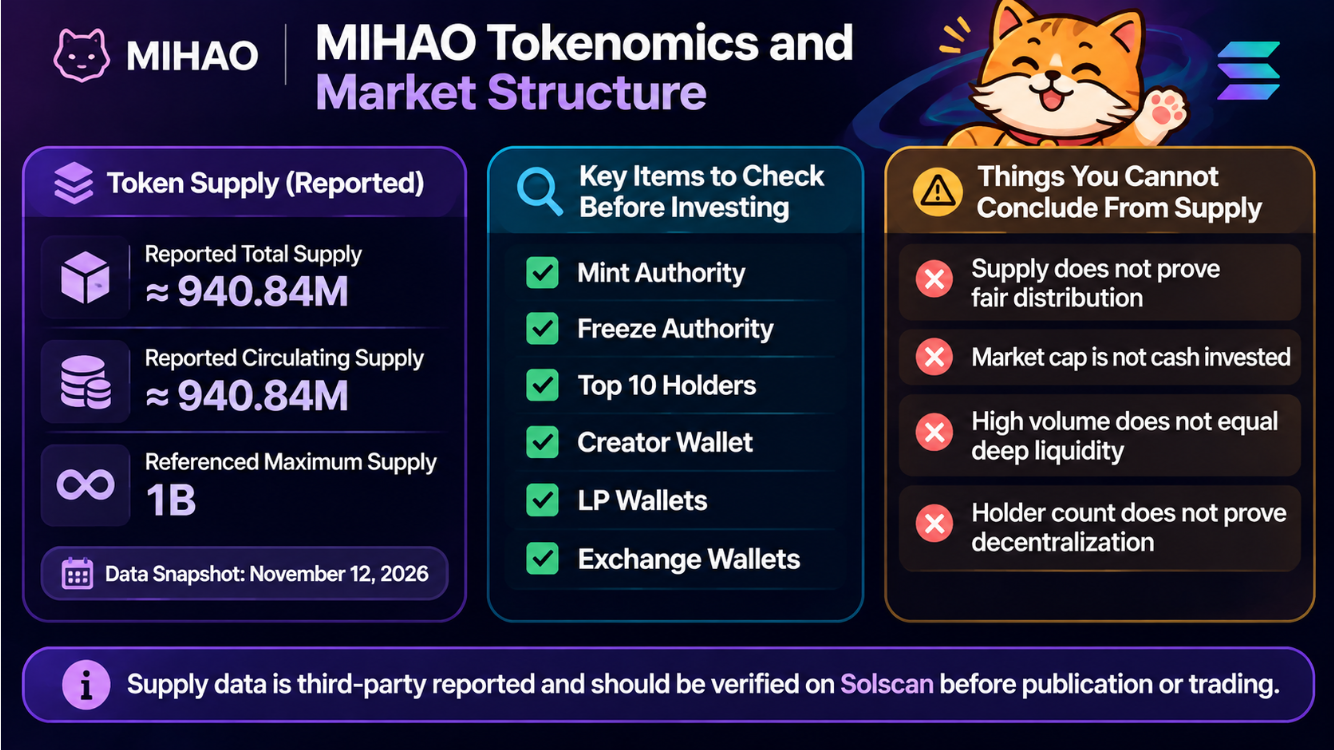
Before trading, compare the entire address across at least two independent sources. Then inspect the token on Solscan, confirm the relevant pool and check mint and freeze authorities. Solana’s official documentation explains that mint authority can create additional units and freeze authority can prevent transfers from token accounts. Authority status therefore matters, although revoked authorities alone cannot eliminate market, liquidity or insider risk.
3. MIHAO Tokenomics: Supply and Holder Distribution
MIHAO appears to have a near-fully circulating supply, but its tokenomics remain simple and speculative. There is no established staking yield, governance right, protocol revenue share or mandatory product payment publicly documented. Supply, ownership concentration and liquidity are therefore more important than a conventional utility narrative.
Total and circulating supply
At the November 12, 2026 snapshot, CoinGecko reported approximately 940.84 million MIHAO as both total and circulating supply, while presenting market capitalization and fully diluted valuation at approximately the same level. The commonly referenced maximum is one billion tokens.
These are third-party figures, not a substitute for on-chain verification. Supply can differ across platforms because of burns, excluded addresses, indexing delays or different definitions of “circulating.” Before making a position-size decision, check the mint’s current supply on Solscan and record the timestamp.
Does MIHAO have token utility?
The official site currently emphasizes memes, PFPs and an ecosystem of paired tokens. It does not document a right to revenue, a fixed yield or a necessary payment function. That means MIHAO’s utility is primarily social: the token can represent membership, identity and participation in the community.
Social utility can support valuable networks, but it is difficult to value. It depends on continued collective belief and participation. If users can enjoy the memes without buying the token, cultural reach may grow without creating proportional token demand.
Holder distribution matters more than the headline holder count
Pump.fun showed about 27,900 holders in one November 12 snapshot. This is useful but incomplete. A healthy distribution analysis must separate:
- the main liquidity-pool account;
- exchange or custody wallets;
- burn or system accounts;
- creator-linked or early wallets;
- ordinary holders;
- clusters that may be controlled by the same party.
A token can have thousands of holders yet remain concentrated if a few economic owners control many tokens. Conversely, a top-holder list can look concentrated because it includes pools or exchange wallets representing many users. Investors should inspect the top 10 and top 20 addresses, follow recent transfers and use wallet-cluster tools cautiously rather than treating a single percentage as conclusive.
Contract and liquidity checks
Before buying, verify five items:
- Supply authority: Can new tokens still be minted?
- Freeze authority: Can an authority freeze accounts?
- Main pool: Is the pool address the one linked from verified sources?
- Liquidity: How much value is actually available on both sides of the pool?
- Sell test: Can a small position be sold at an acceptable price impact?
These checks reduce avoidable errors but cannot prove the investment is safe. A technically transferable token can still lose most of its value.
4. MIHAO Market Performance and Community Growth
MIHAO’s early performance shows intense price discovery rather than a stable valuation. The token is only weeks old, and its market data can change materially within hours. The right approach is to timestamp every figure and analyze price, volume, liquidity, holders and social activity together.
Market snapshot on November 12, 2026
CoinGecko’s November 12 snapshot showed MIHAO near $0.02469, with a market capitalization around $23.23 million, reported 24-hour trading volume around $127.37 million and a 24-hour range of roughly $0.01229 to $0.02575. Its reported all-time high and low matched that very short range because the indexed market history was still limited. See the timestamped CoinGecko market page.
Pump.fun’s page showed a somewhat different snapshot: a price near $0.01827, market cap around $18.3 million, 24-hour volume around $41.8 million, about 27,900 holders and roughly $228,000 of liquidity in the displayed SOL pool. Different timestamps and aggregation methods explain part of the variation. See the official Pump.fun token page.
The discrepancy itself is an investment lesson. A buyer should not select whichever figure supports a desired conclusion. Use one timestamp, one verified contract and clearly identified markets. For execution, inspect the venue where the trade will actually occur.
Why volume is not the same as liquidity
Volume measures how much trading occurred during a period. Liquidity measures how much can be bought or sold without moving the price excessively. A token can report daily volume many times larger than its main pool liquidity because the same capital turns over repeatedly, arbitrage spans venues, bots trade frequently or volume is aggregated across markets.
This creates exit risk. If the main pool contains only a modest amount of quote liquidity, a large sell order can suffer substantial price impact even while the headline 24-hour volume looks impressive. Always simulate the intended trade size before submitting it.
What drove the November surge?
Third-party reports linked the sudden increase in attention to crypto trader Ansem adopting the cat as a profile picture and publicly discussing MIHAO. This appears to have amplified an existing two-week community campaign rather than creating the token. Treat the attribution as third-party reporting unless independently verified from the original social posts.
KOL participation can accelerate distribution, but it also increases concentration of narrative risk. If a significant share of attention depends on one account, a profile change or loss of interest can reverse momentum quickly.
Where is MIHAO traded?
CoinGecko listed PumpSwap as the most active venue and also showed Meteora and Orca markets. BingX displayed a MIHAO/USDT spot pair and announced a November 11, 2026 listing.
Market availability does not guarantee that deposits, withdrawals or trading are enabled in every jurisdiction. Confirm the exact pair, network, order-book depth and local eligibility on the venue itself.
5. MIHAO Price Prediction 2027–2030
There is not enough history to produce a reliable point forecast for MIHAO in 2030. The defensible method is scenario analysis: estimate what market capitalization a future price would require, then ask whether community reach, liquidity, listings and broader crypto conditions could plausibly support it.
Market-cap-based valuation
Using a maximum supply assumption of one billion tokens, the price-to-FDV relationship is straightforward:

These are mathematical scenarios, not forecasts or promised targets. If the actual supply differs, the implied prices change. Even if a headline FDV is reached briefly, insufficient liquidity may prevent many holders from exiting near that valuation.
Bear case: attention and liquidity contract
In a bearish scenario, the KOL catalyst fades, community activity slows, new buyers decline and liquidity migrates to newer Solana memes. MIHAO could fall below a $10 million valuation and, in a severe loss-of-attention event, approach the $5 million scenario or lower.
The downside is not bounded by the current meme library or holder count. If bids disappear, a meme coin can lose 80%–95% of its peak value and still remain technically operational. In an extreme case, major venues could lose liquidity and the practical exit price could be much lower than the last displayed quote.
Base case: a smaller but persistent community survives
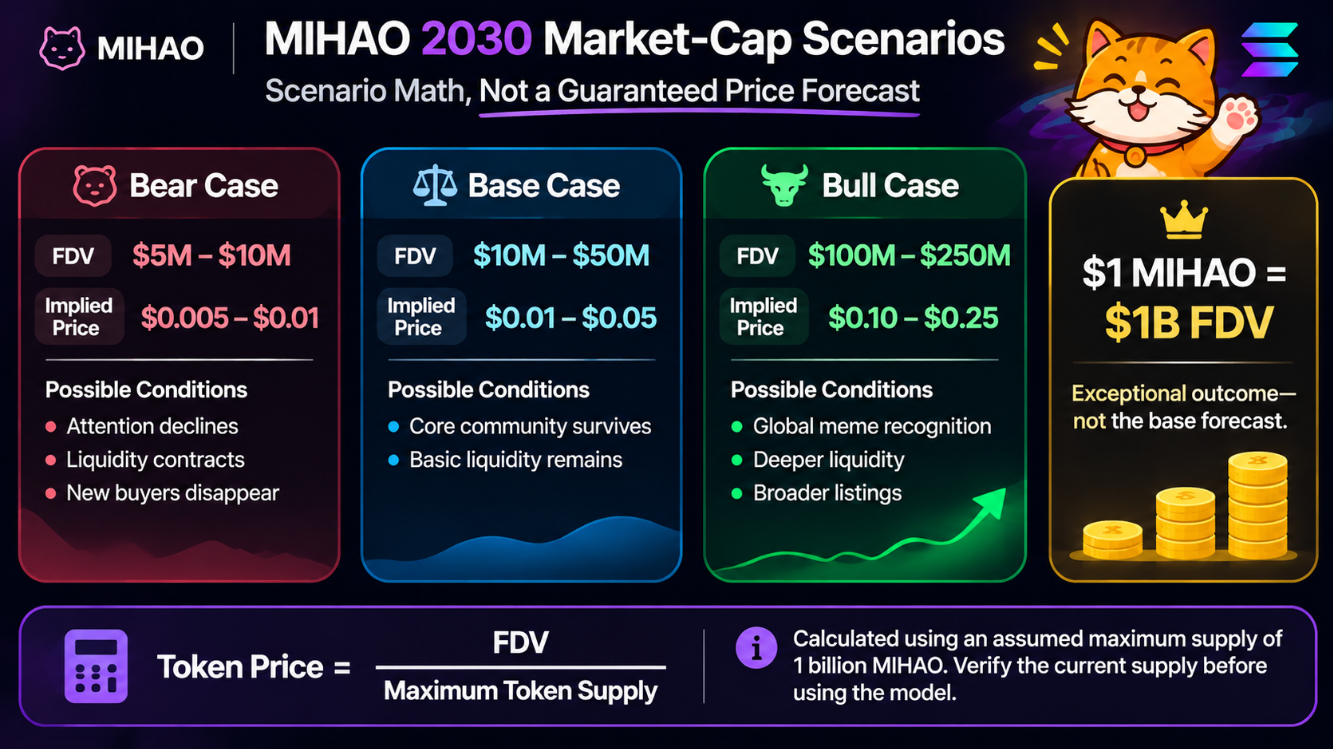
In a base scenario, MIHAO retains a core community, continues publishing content and remains tradable, but does not become a leading global meme brand. A broad 10 million–50 million valuation band may be a more useful framework than one exact price. At one billion tokens, that corresponds to roughly 0.01–0.05.
This range is deliberately wide. The difference between $0.01 and $0.05 depends on liquidity, holder growth, exchange access and the broader Solana risk cycle. A surviving community alone does not justify the top of the range.
Bull case: MIHAO becomes a durable international meme brand
In a bullish scenario, the cat develops a durable PFP culture, organic content continues across languages, holder growth persists beyond the initial KOL event, liquidity deepens and more credible exchanges add markets. A 100 million–250 million valuation would imply approximately 0.10–0.25 at one billion tokens.
Reaching $500 million or $1 billion would require a far larger outcome: widespread recognition, deep and distributed liquidity, a long-lived community and favorable crypto market conditions. It is mathematically possible but should be treated as a low-confidence tail scenario, not a base expectation.
Can MIHAO reach $0.05, $0.10 or $1 by 2030?
- **$0.05:** Requires about a $50 million FDV. This is achievable in arithmetic terms and would require MIHAO to more than double the November 12 snapshot valuation while retaining sufficient liquidity and attention.
- **$0.10:** Requires about a $100 million FDV. MIHAO would need to mature from a newly promoted micro-cap meme into a more established Solana community asset.
- **$1.00:** Requires about a $1 billion FDV. This would place MIHAO among major meme-coin valuations and demands evidence far beyond current data. It is possible only as an exceptional bull case, not a reasonable default forecast.
How BTC and ETH cycles affect MIHAO
Bitcoin often sets the broad market’s risk appetite. When BTC falls sharply, investors frequently reduce exposure to high-beta assets first, and thin meme markets can decline much more. Readers can use a Bitcoin price prediction to explore macro scenarios, while remembering that it cannot forecast MIHAO directly.
ETH can help indicate appetite for on-chain assets and speculative activity, although Solana and SOL activity are more directly relevant to MIHAO. An Ethereum price prediction is therefore a secondary market reference, not a fundamental input.
6. Where to Buy MIHAO
MIHAO can be purchased through verified Solana DEX pools and, where legally available, centralized exchanges that have opened a spot market. The safest route is the one whose contract, network, liquidity and withdrawal status you can verify—not necessarily the venue with the loudest promotion.
Verified markets at the review date
- PumpSwap: MIHAO/WSOL was the most active market listed by CoinGecko.
- Meteora and Orca: CoinGecko showed additional Solana liquidity pools.
- BingX: The exchange displayed a MIHAO/USDT spot market and a November 11 listing notice.
Raydium may surface routes through aggregators or additional pools, but the exact pool and available liquidity must be checked at execution time. HIBT was not included as a verified MIHAO market in the sources reviewed for this article, so this guide does not claim that MIHAO can currently be bought there.
How to buy MIHAO on a Solana DEX
- Install a reputable Solana-compatible wallet and back up the recovery phrase offline.
- Acquire SOL through a lawful exchange or on-ramp and transfer a small amount to the wallet.
- Open MIHAO’s official website or verified Pump.fun page. Avoid search ads and links sent through private messages.
- Confirm the full mint address:
4CxjZyMNoF1p6eXHXHv1TWpS2X47CuUmLwtGe18spump. - Open the linked PumpSwap pool or a verified aggregator route.
- Enter the amount of SOL to swap, leaving enough SOL for network fees.
- Review the minimum received, slippage tolerance and estimated price impact.
- Approve a small test trade first.
- Confirm that the received token’s mint matches the official address.
- Test a small sale before committing a larger position.
Avoid setting unlimited slippage merely to force a transaction through. Excessive slippage can produce a much worse execution price and expose the trade to MEV or rapidly changing pool conditions.
How to buy MIHAO on BingX
Where BingX is available and the pair remains active:
- Create an account through the official website and complete any required identity checks.
- Deposit USDT using a network supported by both the sending and receiving platforms.
- Search for the exact MIHAO/USDT spot pair.
- Inspect the best bid, best ask, spread and order-book depth.
- Use a limit order if you want to control the maximum purchase price; a market order prioritizes execution and can suffer slippage.
- Review the fee and order total before confirming.
- Verify the filled quantity and average price in the trade history.
- If withdrawing, confirm that Solana withdrawals are enabled and that the destination wallet supports the official mint.
Centralized custody reduces wallet complexity but introduces platform, access and withdrawal risk. DEX trading gives users direct custody but adds contract, phishing, network and execution risks. Neither method is universally safer.
7. MIHAO Investment Strategy
MIHAO should be treated as a high-risk satellite position, not a core portfolio holding. The strategy must start with the maximum acceptable loss and available exit liquidity—not with a desired profit target.
Short-term strategy
Short-term traders should monitor one-hour and four-hour price structure, volume, pool liquidity, buy/sell imbalance, price impact and large-wallet transfers. RSI or MACD can describe momentum, but neither can detect an insider sale or disappearing liquidity.
Do not buy solely because a KOL posts about the token. By the time a promotion is visible, early holders may already have substantial unrealized gains. A safer process is to wait for price discovery, check whether liquidity and holders continue growing, and avoid entering when the order size itself would materially move the market.
Medium-term strategy
Over one to three months, evaluate whether MIHAO is gaining new participants rather than recycling the same capital. Track:
- weekly unique traders and holders;
- community growth and engagement quality;
- meme contributions from independent users;
- exchange additions and withdrawal support;
- average pool liquidity, not just peak liquidity;
- changes in top-holder concentration;
- sustained volume after the original catalyst fades.
If price rises while unique users, liquidity and social participation decline, the divergence is a warning rather than confirmation.
Long-term strategy through 2030
“Hold until 2030” is not a thesis. Long-term ownership requires periodic revalidation because meme demand can disappear without a business failure or security incident. Review the position monthly during high volatility and at least quarterly after activity normalizes.
The long-term case weakens if the official site stops updating, organic content collapses, exchange support shrinks, liquidity trends downward or a few wallets accumulate excessive control. The case improves if the identity survives multiple market cycles, participation broadens and liquidity deepens without relying on a single promoter.
Position sizing and staged entry
A practical framework is:
- Decide the maximum portfolio loss you can accept from MIHAO.
- Estimate a severe drawdown—50% is not conservative for a new meme coin; near-total loss is possible.
- Set the position so that the severe drawdown remains within the loss budget.
- Enter in stages only if the original thesis strengthens.
- Predefine exit conditions for liquidity decline, holder concentration or narrative failure.
For example, if an investor is willing to risk only $20 and assumes the position could fall 80%, the maximum position from that rule is $25. This is educational arithmetic, not a recommended allocation.
Never use borrowed money, essential savings or high leverage for a token whose valuation depends mainly on attention.
8. Risks of Investing in Ni Hao Cat
The greatest MIHAO risk is not a single technical flaw. It is the combination of fragile attention, limited valuation anchors, concentrated market structure and potentially shallow exit liquidity.
Volatility and narrative risk
MIHAO can rise several-fold as social attention compounds and fall just as quickly when buyers stop arriving. Its meme may remain entertaining even if the token loses most of its value. Cultural success and investment returns are related but not identical.
Liquidity and exit risk
Reported volume can be much larger than executable liquidity. Multiple pools fragment depth, and the displayed price may apply only to small trades. A large sell can move the pool price, trigger arbitrage and produce a realized price far below the pre-trade quote.
Whale, creator and insider risk
Early buyers can have a large cost advantage. A creator, KOL or coordinated wallet cluster can influence both narrative and supply. Do not accuse addresses without evidence, but do monitor transfers from early wallets into pools or exchanges.
Contract and fake-token risk
Anyone can create a Solana token using the same name and ticker. Never rely on “MIHAO” or the cat logo alone. Verify the full mint, authority status and pool. Use official links, not sponsored search results or direct messages.
Network and wallet risk
Users may lose funds through phishing, malicious wallet approvals, compromised seed phrases, failed swaps or excessive slippage. Solana congestion or venue outages can also prevent an intended exit during extreme volatility.
Can MIHAO go to zero?
Yes. MIHAO lacks mature cash flow and indispensable utility, so it can experience an extreme price decline, liquidity collapse or permanent loss of attention. A revoked mint authority or functional contract would not prevent this economic outcome.
9. MIHAO vs Other Solana Meme Coins
MIHAO competes for the same scarce resource as thousands of other meme coins: attention. Its bilingual cat identity and PFP tools may help it stand out, but lasting success depends on whether the community can produce culture faster than the market produces substitutes.
Compare meme coins across six dimensions:
- Identity: Can a user recognize the meme instantly without explanation?
- Participation: Are users creating content, or only posting price targets?
- Distribution: Is growth organic across many accounts or dependent on a few KOLs?
- Ownership: Is the supply broadly distributed after excluding pools and custody wallets?
- Liquidity: Can realistic position sizes enter and exit without excessive impact?
- Persistence: Has the community survived declining prices and quieter market periods?
MIHAO currently scores strongly on visual identity and recent attention, but its persistence is unproven because it launched only in late October 2026. Any comparison with older cat coins must account for that enormous difference in track record.
10. Can Ni Hao Cat Survive Until 2030?
MIHAO can survive until 2030 only if it becomes more than a short-lived trade. Survival does not require conventional utility, but it does require continued cultural output, broad ownership, usable liquidity and a community willing to remain active when the price is not rising.
Four checkpoints are especially useful:
- After the KOL catalyst: Does activity remain once promotional attention normalizes?
- After the first major drawdown: Do holders keep creating and participating, or only demand price recovery?
- Across a weaker market cycle: Can liquidity and exchange support survive prolonged risk-off conditions?
- By 2028–2029: Is MIHAO still a recognizable, independently maintained identity rather than an archived website and thin pool?
The official meme library and PFP generator are constructive starting points, but the project has not yet demonstrated multi-cycle resilience. That uncertainty should be reflected in position size and required return.
11. Final Verdict: Is MIHAO Worth Buying?
MIHAO is worth researching as an early Solana meme trade, but the available evidence does not justify treating it as a proven long-term investment. Its strengths are a memorable visual identity, simple cross-language theme, active community tooling and rapid market attention. Its weaknesses are the lack of cash flow, limited token utility, very short history and potentially fragile liquidity.
My conclusion is clear:
- For experienced meme traders: MIHAO may offer a speculative opportunity if the official contract is verified, liquidity can support the intended trade and loss is strictly capped.
- For Solana ecosystem users: It can be studied as a community asset, but familiarity with wallets does not reduce valuation risk.
- For long-term value investors: Evidence is insufficient. There is no dependable cash-flow or utility anchor.
- For beginners or low-risk investors: It is unsuitable until they understand contract verification, slippage, custody and the possibility of near-total loss.
The most useful question is not “Can MIHAO reach $1?” It is “Will the community, liquidity and distribution needed for a $1 billion valuation exist—and can I exit safely if they do not?” At present, that outcome remains speculative.
12. Frequently Asked Questions About MIHAO
What is Ni Hao Cat (MIHAO)?
Ni Hao Cat is a community-driven meme coin on Solana. Its brand uses an orange mustached cat, the Chinese greeting “你好” and community-made memes and profile pictures. MIHAO does not currently have an established protocol-revenue model or essential token utility.
What blockchain is MIHAO on?
MIHAO is on Solana. It was created through Pump.fun and now trades through Solana liquidity pools, including PumpSwap. Users need a Solana-compatible wallet and SOL for network fees when trading on a DEX.
When was MIHAO launched?
The verified Pump.fun page says MIHAO was created on October 25, 2026. Because it has only weeks of trading history, long-term price models have very limited evidence and should be treated as scenarios rather than reliable forecasts.
What is the official MIHAO contract address?
The official Solana mint is 4CxjZyMNoF1p6eXHXHv1TWpS2X47CuUmLwtGe18spump. Verify the entire address on the official website, Pump.fun and Solscan before trading. A matching name, ticker or logo is not sufficient.
Does MIHAO have real utility?
MIHAO’s currently documented role is mainly social and community-based. The official site offers memes, a PFP generator and an ecosystem directory, but it does not establish staking yield, governance, revenue sharing or a necessary payment use.
What is the total supply of MIHAO?
CoinGecko reported approximately 940.84 million total and circulating tokens on November 12, 2026, with a commonly referenced maximum of one billion. Because data providers can use different methodologies, verify the current on-chain supply before relying on it.
Where can I buy MIHAO?
At the review date, CoinGecko listed PumpSwap, Meteora and Orca markets, while BingX displayed a MIHAO/USDT spot pair. Availability, liquidity, deposits, withdrawals and regional access can change, so confirm the venue’s current status before funding an account.
How do I buy MIHAO on PumpSwap?
Connect a Solana wallet through an official link, confirm the full MIHAO mint address, select the verified MIHAO/WSOL pool, review slippage and price impact, and make a small test swap. Keep enough SOL for fees and test a small sale before increasing exposure.
Can MIHAO reach $0.10 by 2030?
At a one-billion-token maximum supply, $0.10 implies a $100 million FDV. That outcome requires sustained global attention, broader listings and materially deeper liquidity. It is possible as a bullish scenario but cannot be supported as a reliable forecast from MIHAO’s short history.
Can MIHAO reach $1 by 2030?
$1 would imply a $1 billion FDV at one billion tokens. MIHAO would need to become a major, durable meme brand with deep liquidity and multi-cycle relevance. This should be viewed as a low-confidence tail scenario, not a reasonable base case.
Is MIHAO a good long-term investment?
MIHAO is not yet a proven long-term investment. It has no mature cash flow, limited documented utility and only a short trading history. A long-term case would require evidence that its community, liquidity and cultural relevance can survive multiple market cycles.
Is MIHAO safe to buy?
No cryptocurrency is inherently safe, and MIHAO has high volatility, liquidity, holder-concentration, phishing and narrative risks. Contract verification reduces the risk of buying an imitation but does not protect against price collapse or disappearing demand.
Sources and verification notes
- Ni Hao Cat official website — project identity, contract, meme collection and PFP features.
- Official Pump.fun MIHAO page — creation date, pool snapshot, holders and trading activity.
- CoinGecko MIHAO market page — third-party price, supply, market-cap and market listings.
- Solscan token page — on-chain token and holder verification.
- Solana token documentation — mint and freeze authority concepts.
- Pump.fun bonding-curve documentation — launch, pricing and migration mechanics.
- BingX MIHAO/USDT market — centralized spot-market availability at the review date.
Market figures in this article are snapshots and should not be treated as current after the review date. Recheck the official mint, pool liquidity, holder distribution, venue status and fees immediately before any transaction.